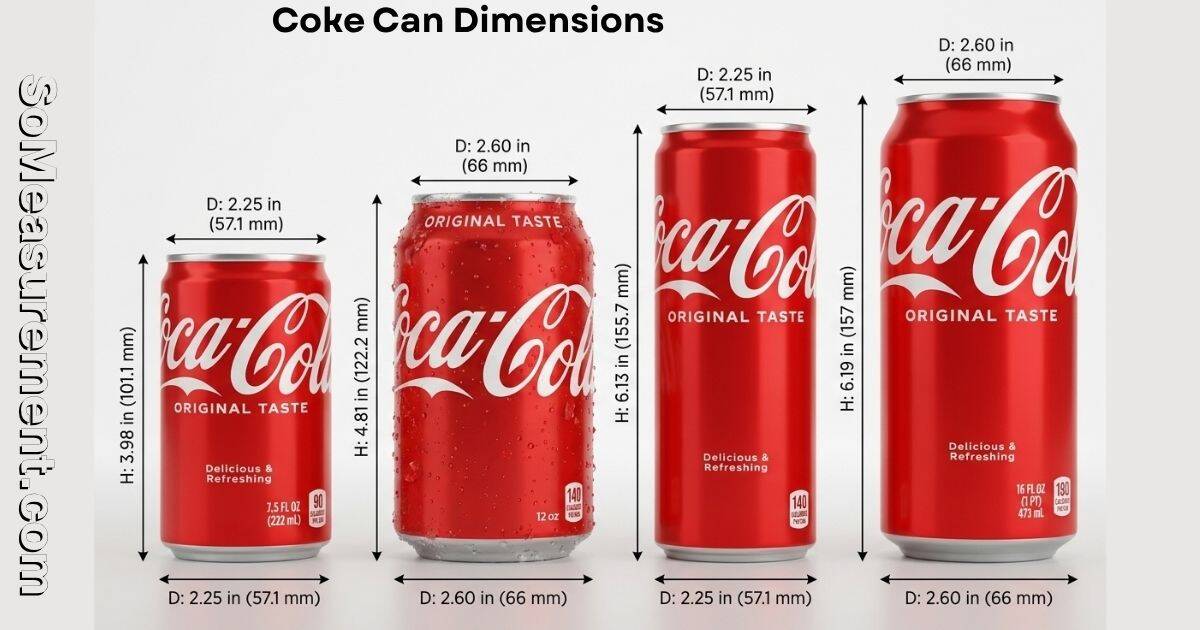
You grabbed a Coke can holder online, it arrived, and your can doesn’t fit. Or you’re designing a label and the edges keep wrapping wrong. Or you just need one accurate number for a 3D print and every site gives you something slightly different.
This article fixes all of that. Every size, every format, explained in plain English with real-world context so you know which number to use and why.
First, Why Are There So Many Coke Can Sizes?
Most people think a Coke can is just… a Coke can. One size, one shape. But Coca-Cola actually sells drinks in at least five different can formats depending on the product, country, and market strategy.
The standard 12 oz can you grew up with is different from the tall skinny can your Coke Zero comes in. The mini can your kid drinks is different again. And the UK version of the “standard” can? Slightly shorter than the US one, even though they look identical in photos.
These differences are small enough to miss with your eyes and large enough to ruin a custom project. So here is exactly what you need to know.
The Standard US Coke Can (12 oz)
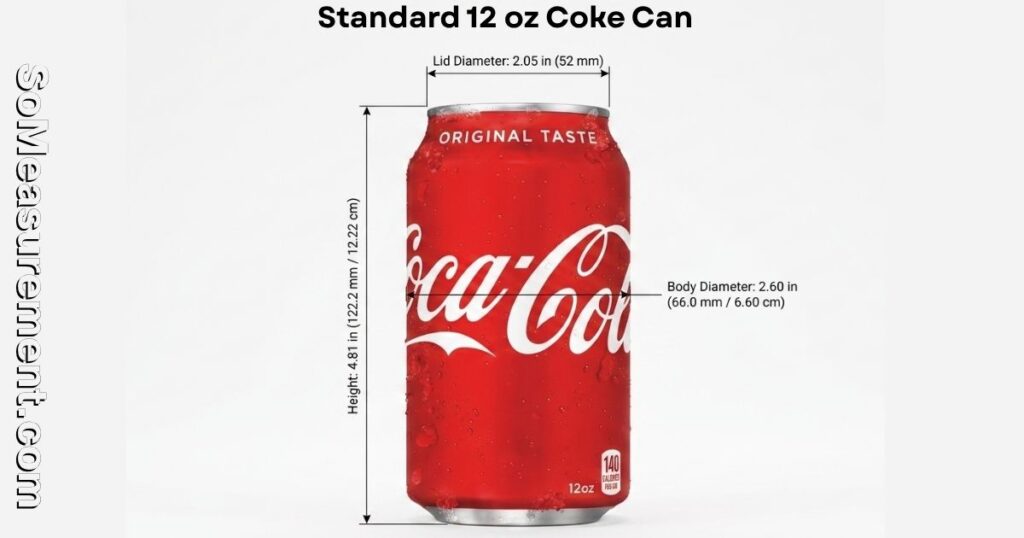
This is the classic. The one you picture when someone says “a can of Coke.”
| Height | 4.81 in | 122.2 mm | 12.22 cm |
| Body diameter | 2.60 in | 66.0 mm | 6.60 cm |
| Lid diameter | 2.05 in | 52.0 mm | 5.20 cm |
| Circumference | 8.16 in | 207.3 mm | 20.73 cm |
A few things worth knowing about these numbers:
The lid is noticeably narrower than the body. That tapered neck at the top is not a design choice, it saves aluminum. At the scale Coca-Cola produces cans, even a few millimeters of material savings adds up to millions of dollars. The lid is 52 mm wide while the body is 66 mm. That 14 mm difference matters if you are designing something that grips the can near the top.
The bottom is domed inward, not flat. Internal carbonation pressure inside a sealed can exceeds 90 PSI. A domed bottom distributes that pressure evenly instead of bulging outward. When you are measuring a can for a holder or insert, measure the body diameter, not the bottom.
For 3D printing: Use 122.2 mm for height and 66 mm for diameter. The number “4.83 inches” circulates online as a rounded approximation but 122.2 mm is the verified manufacturing spec.
3The UK and European Coke Can Sizes (330ml)
| Height | 115.2 mm | 4.52 in |
| Diameter | 66.3 mm | 2.61 in |
| Volume | 330 ml | 11.2 fl oz |
This one catches people out constantly. The UK/EU can is almost identical in width to the US can (66.3 mm vs 66.0 mm), but it is 7 mm shorter. On screen or in photos, you cannot tell them apart. In a tight-fit project, that 7 mm gap becomes a real problem.
If you are buying a foam insert, a custom sleeve, or a labeling template made for “standard” cans, always check which standard the seller means. A product built for UK cans will leave a gap under a US can. A product built for US cans will sit too tight over a UK one.
The Sleek Can (Coke Zero Sugar, Coke Energy, Flavored Lines)
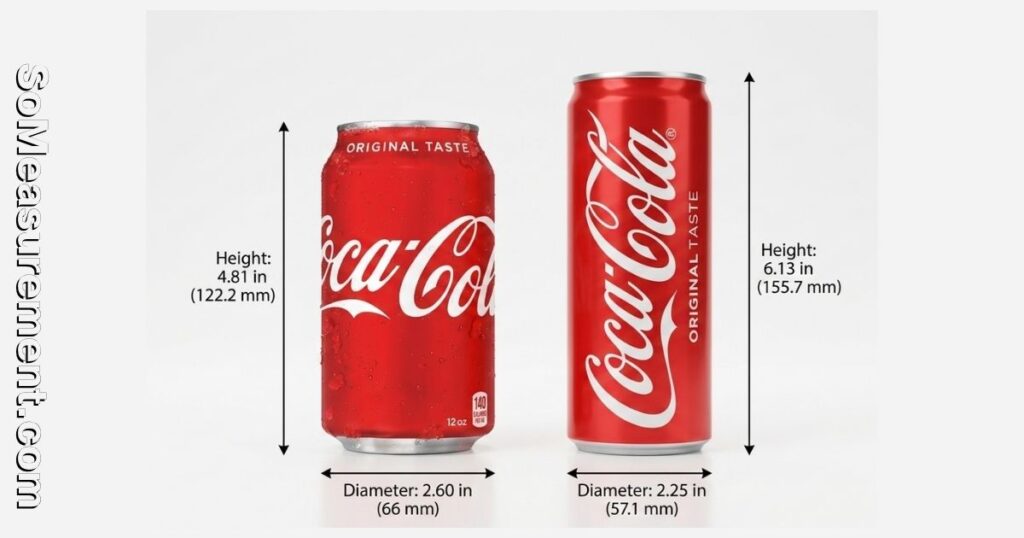
This is the tall, thin can. If your Coke looks more like an energy drink can, it’s a sleek.
| Height | 155.7 mm | 6.13 in |
| Diameter | 57.1 mm | 2.25 in |
| Circumference | 179.07 mm | 7.05 in |
| Volume | 355 ml | 12 oz |
Here is the part that surprises most people: a sleek can holds exactly the same amount of liquid as a standard 12 oz can. Same 355 ml. The tall thin shape is a branding decision, not a volume one. Coke uses the sleek format to position certain products as premium or health-conscious.
What this means practically: if you buy a cup holder, cooler sleeve, or car mount designed for a standard 12 oz Coke, a sleek can will rattle around in it. The sleek can is nearly an inch taller and almost half an inch thinner. They are not interchangeable.
The Mini Coke Can (7.5 oz)
| Height | 101.1 mm | 3.98 in |
| Diameter | 57.1 mm | 2.25 in |
| Volume | 222 ml | 7.5 fl oz |
The mini can is shorter than a standard can, which most people expect. What they do not expect is that it is also narrower, sharing its 57.1 mm diameter with the sleek can rather than the standard 12 oz. It is a completely different shape, not just a scaled-down version of the classic.
This matters for display racks, custom holders, and gift packaging. A slot designed for a standard 12 oz can is too wide for a mini.
Large Format Cans: Tallboy and Stovepipe
| 16 oz Tallboy | 157 mm / 6.19 in | 66 mm / 2.60 in | 473 ml |
| 19.2 oz Stovepipe | 190.5 mm / 7.50 in | 66 mm / 2.60 in | 568 ml |
Both of these share the same 66 mm diameter as the standard 12 oz can. A cup holder that fits a regular Coke will fit a tallboy or stovepipe too. Only the height changes, so clearance is the only thing to check.
Full Coke can Sizes Comparison at a Glance
| Mini 7.5 oz | 101.1 mm / 3.98 in | 57.1 mm | 222 ml |
| EU/UK 330ml | 115.2 mm / 4.52 in | 66.3 mm | 330 ml |
| Standard US 12 oz | 122.2 mm / 4.81 in | 66.0 mm | 355 ml |
| Slim 250ml | 134.0 mm / 5.28 in | 53.0 mm | 250 ml |
| Sleek 12 oz | 155.7 mm / 6.13 in | 57.1 mm | 355 ml |
| 16 oz Tallboy | 157.0 mm / 6.19 in | 66.0 mm | 473 ml |
| 19.2 oz Stovepipe | 190.5 mm / 7.50 in | 66.0 mm | 568 ml |
Designing a Label? Read This Before You Start
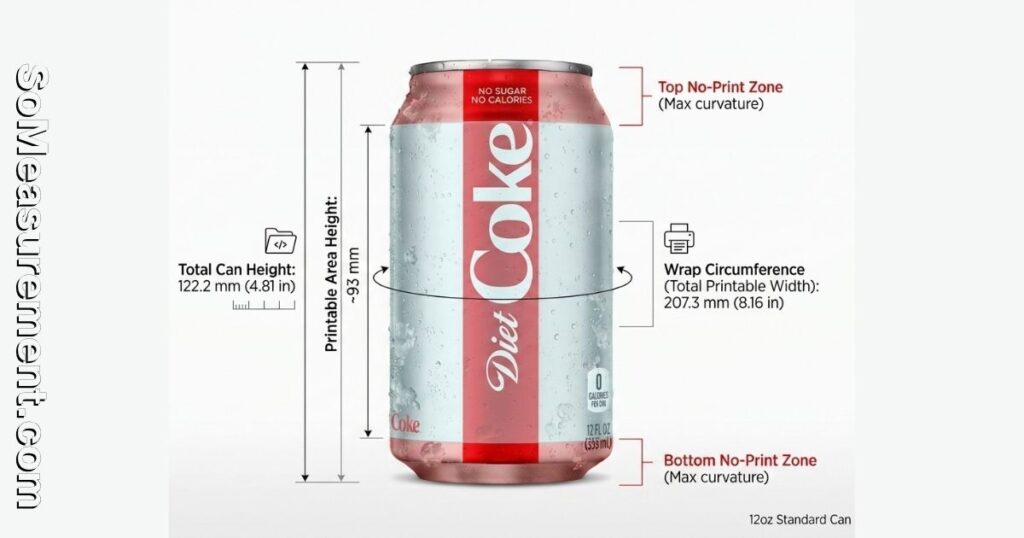
If you are creating a custom label for a Coke can, diameter is not the number you need. You need circumference, because your label wraps around the outside.
| Standard / Tallboy / Stovepipe | 66 mm | 207.3 mm |
| Sleek / Mini | 57.1 mm | 179.07 mm |
There is another catch. You cannot use the full height of the can for your label. The top neck taper and the domed bottom take up space where flat graphics will distort or not stick properly. On a standard can, you only have about 90 to 95 mm of usable flat label space in the middle of the body.
Design your artwork within that zone. Anything outside it will wrap around a curve and look wrong on the finished product.
Which Number Should You Actually Use?
It depends on what you are making.
Building a holder or insert? Diameter is your critical measurement. A can that is too wide will not go in. Height problems are much easier to work around.
3D printing a model? Use millimeters. Height 122.2 mm, body diameter 66.0 mm for the standard US can. These are the actual manufacturing specs.
Designing a label? Use circumference for width (207.3 mm for standard) and keep your design within 90 to 95 mm of vertical height.
Buying a sleeve or cooler? Confirm whether it is built for sleek (57.1 mm) or standard (66 mm) cans. That single difference is responsible for most “it doesn’t fit” complaints.
Quick Reference: Weight and Materials
These come up less often but are useful for shipping, physics projects, or product design work.
- Empty can weight: 14 to 15 grams
- Full 12 oz can weight: 370 to 380 grams
- Body material: 3004 aluminum alloy
- Lid material: 5182 aluminum alloy (harder, to handle the pull-tab stress)
- Recommended shelf clearance for standard US cans: at least 5 inches vertical
The lid uses a different, harder alloy than the body because the pull-tab mechanism puts a lot of localized stress on a small area. The body just needs to hold pressure and resist denting during shipping.
The Three Most Common Mistakes
Assuming UK and US cans are the same size. They are the same width. The UK version is 7 mm shorter. That is invisible on a screen and very real in practice.
Thinking the sleek can holds less liquid. It holds exactly the same 355 ml as a standard 12 oz. The shape is different, the volume is not.
Treating the mini as a small standard can. The mini and standard cans have different diameters. They are genuinely different shapes, not the same shape at different sizes.
That covers every format in production today. If you have a specific project and need help figuring out which measurement applies, the comment section is open.
Measurements reflect current Coca-Cola manufacturing specifications as of 2026. Minor tolerances of plus or minus 0.5 mm may exist between individual production batches.
Related Posts:
Monster Can Dimensions: Size, Height & Diameter Guide 2026
Red Bull Can Dimensions — Size, Height & Diameter Guide 2026

Lev is passionate about helping readers understand sizes and dimensions of everyday objects. With a focus on clarity and practical examples, Lev shares accurate, trustworthy insights that make measurements relatable, useful, and easy to visualize for everyone.