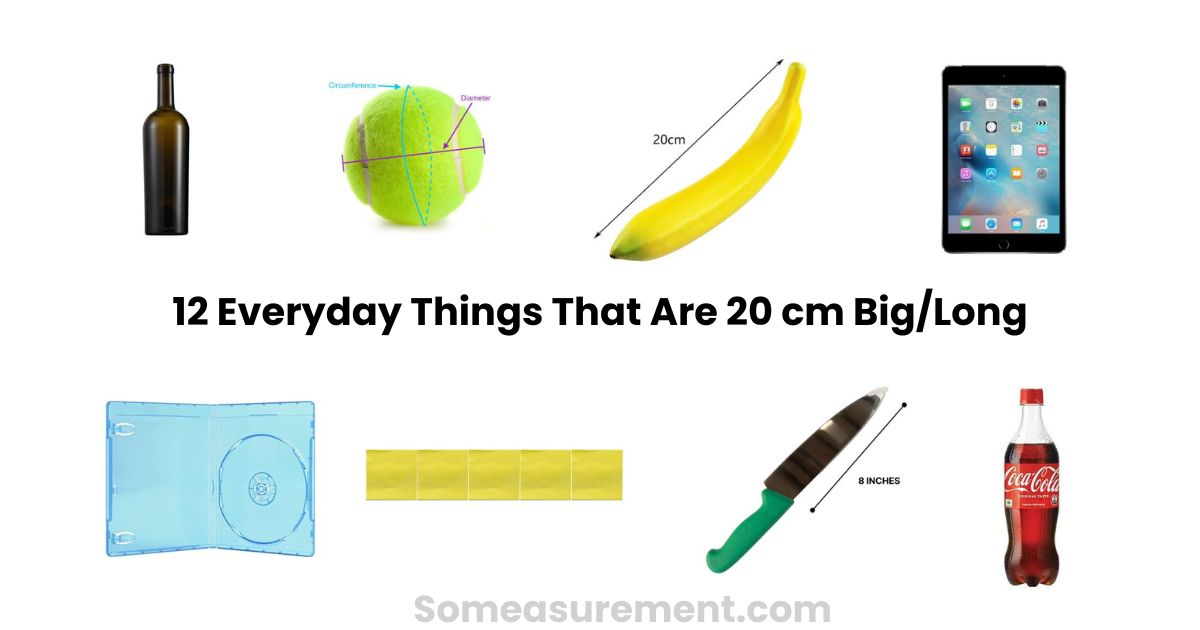
Twenty centimeters sits in a sweet spot of everyday life. It is long enough to span a meaningful distance but compact enough to fit comfortably in your hand, on a plate, or inside a bag. Converted, it works out to roughly 7.87 inches, or just under 8 inches, which gives it a surprisingly familiar feeling once you start looking for it around the house.
The twelve objects below all come close to 20 cm in at least one dimension, whether that is length, height, diameter, or width. Some are exact by design, others land in the ballpark by coincidence. Either way, they give you a reliable mental anchor for this size.
12 Daily-Use Things That Measure About 20 cm
| Object | Category | Dimension (cm) |
| iPad Mini | Electronics | 19.5–20 |
| 20 oz Plastic Soda Bottle | Beverage container | ~20 |
| Dinner Fork | Kitchen utensil | ~20 |
| No. 2 Pencil (new) | School supply | 19–20 |
| DVD or Blu-ray Case | Home media | 19–20 |
| Post-it Notes (about 2.6 notes wide) | Office supply | 20 |
| 8-inch Chef’s Knife Blade | Kitchen utensil | 20.3 |
| 8-inch Frying Pan (diameter) | Cookware | 20.3 |
| Wine Bottle (base to shoulder) | Glass bottle | ~20 |
| Tennis Ball (circumference) | Sports equipment | 20–21 |
| Tissue Box (long side) | Household item | 19–21 |
| Medium Banana | Food | 18–21 |
iPad Mini

The iPad Mini stands at roughly 195 to 200 mm tall depending on the generation, placing its overall height right at the 20 cm mark. That slim profile is part of what makes it popular for reading and sketching, since it feels closer to a paperback book than a full-sized tablet.
What makes it a genuinely useful reference is that most people either own one or have held one. If you have ever gripped an iPad Mini in portrait mode, that distance from your pinky to your index finger stretched across the device is about what 20 cm feels like in your hand.
20-Ounce Plastic Soda Bottle

The standard 20-ounce plastic soda bottle used across the United States measures close to 20 cm tall. The exact height shifts slightly between brands and bottle designs, but the range stays consistently between 19 and 21 cm for this bottle size, making it a reliable visual anchor.
The shape also helps with intuition. Unlike a flat object, the bottle gives you a sense of 20 cm as a vertical distance, which is useful when you are trying to picture height rather than length. Standing one on a table and looking at it straight on gives a clear impression of how modest yet practical this measurement actually is.
Dinner Fork

A standard dinner fork used in most Western table settings runs between 18 and 21 cm in total length, with 20 cm being a common and widely used size. The tines take up roughly a third of that length, and the handle fills out the rest with enough grip to feel balanced in use.
For measurement purposes, the fork is particularly helpful because it is rigid and flat, making it easy to lay alongside another object for a side-by-side comparison. Most households have at least one, and the size is consistent enough across manufacturers to serve as a dependable everyday reference.
Standard No. 2 Pencil

A brand-new, unsharpened No. 2 pencil measures almost exactly 19 cm long, close enough to 20 cm that it functions as one of the most accessible references you can find. This length has remained a near-universal standard for decades, making it consistent regardless of brand.
The pencil is especially useful for estimating length on a surface. Lay it next to any flat object and you have an instant rough ruler. Once sharpened and shortened through use, it obviously loses some of that length, so for measurement reference purposes a fresh, unused pencil works best.
DVD or Blu-ray Case

A standard DVD or Blu-ray case measures 19 cm tall, 13.5 cm wide, and about 1.4 cm thick. The height of 19 cm places it just a hair under 20 cm, which is close enough that it regularly serves as a practical stand-in for this measurement.
The case is rigid and has clearly defined edges, which makes it easier to use for comparison than soft or flexible objects. If you have a stack of movies at home, pulling one out gives you an immediate physical sense of what 20 cm looks like as a vertical dimension, including the straight, clean edges that make comparison straightforward.
Read more: How Big Is 1 cm? Everyday Things that are 1 cm Long or Big
Five Post-it Notes Side by Side

A standard Post-it Note measures 76 mm on each side, which works out to 7.6 cm. Line up five of them edge to edge in a row and the combined width comes to exactly 38 cm… so three of them laid horizontally gives 22.8 cm and two gives 15.2 cm. The more accurate approach is to place two full notes plus about two-thirds of a third note to reach 20 cm, though this is more of a mathematical exercise than a clean visual.
A simpler and more practical use is stacking them: two sticky note pads placed on top of each other, if each pad is about 10 cm tall, gives you the 20 cm vertically. The individual note reference is most useful when you have a ruler nearby to verify, rather than as a stand-alone estimation tool.
8-Inch Chef’s Knife Blade

An 8-inch chef’s knife blade measures almost exactly 20.3 cm, which makes it one of the most precise natural references for 20 cm you can find in a kitchen. The 8-inch chef’s knife is also one of the most common blade lengths sold, so there is a good chance one already lives in your kitchen drawer.
The blade length is measured from the heel, where it meets the handle, to the tip. This distinction matters because the full knife including the handle is considerably longer. When using the knife as a reference, look only at the blade portion, not the entire tool.
Read also: How Big Is 6 cm? Here’s What It Actually Looks Like
8-Inch Frying Pan

An 8-inch frying pan has a cooking surface diameter of roughly 20 cm at the base, though the outer rim tends to measure slightly wider. This is one case where the stated size and the actual usable surface align closely with 20 cm, since manufacturers typically measure pans across the top interior.
The round shape gives a useful sense of 20 cm as a diameter rather than a straight line, which helps when you are trying to picture circular or curved spaces. If you ever need to judge whether something circular will fit inside a 20 cm boundary, this pan gives you a practical physical reference to test against.
Wine Bottle — Base to Shoulder

A standard 750 ml wine bottle stands about 30 cm tall in total, but from the base to the shoulder, where the neck begins to narrow, the measurement lands close to 20 cm. This lower section of the bottle is cylindrical and relatively consistent across most standard bottle shapes.
The wine bottle reference is particularly useful for visualizing 20 cm as a lower vertical portion of a taller object. It also illustrates that 20 cm is a meaningful but not dominant part of a larger whole, which can help calibrate your mental scale when thinking about how this measurement fits within bigger objects or spaces.
Read more: How Big Is 30 cm? Here’s What It Actually Looks Like in Real Life
Tennis Ball Circumference

A regulation tennis ball has a diameter of roughly 6.7 cm, which gives it a circumference of about 21 cm. That outer circumference sits just above the 20 cm mark, making it a close and accessible reference for this measurement in a curved, three-dimensional form.
The tennis ball is one of the few everyday objects that naturally shows you 20 cm as a curved distance rather than a straight line. If you have a soft tape measure, wrapping it around a tennis ball confirms the circumference and gives you a tactile sense of 20 cm in a way that flat objects cannot replicate.
Read more: How Big Is 10 cm? Here’s What It Actually Looks Like in Real Life
Tissue Box

A standard rectangular tissue box typically measures between 19 and 22 cm along its longest side, depending on the brand and product line. Most common tissue boxes fall right around 20 cm in length, which makes them a practical household reference especially since they sit out in plain sight in most rooms.
The box is also useful because it has three distinct dimensions, which gives you a sense of 20 cm relative to the smaller width and height of the same object. Picking it up and looking at the longest edge gives an immediate real-world sense of how this length relates to a familiar object you interact with regularly.
Medium Banana

A medium banana typically measures between 18 and 22 cm along its curved outer edge, placing 20 cm squarely in the middle of what most people would consider a normal-sized banana. The measurement follows the curve of the fruit rather than a straight-line distance from tip to tip, so the actual straight length is a bit shorter.
The banana is widely recognized as a casual measurement reference, partly because of its consistent availability and partly because most people have a reasonable intuitive sense of what a medium banana looks like. For rough estimation purposes it works well, but because bananas naturally vary in size, it is better suited as a general visual aid than a precise measurement tool.
Putting 20 cm in Perspective
Twenty centimeters is short enough to hold in one hand and long enough to be a meaningful length in everyday objects. It shows up across kitchenware, stationery, electronics, and food, which means you are rarely far from something that can give you an immediate visual reference. Whether you need to estimate a gap, check whether something will fit, or simply picture the scale of an item you are about to buy, these twelve objects give you a practical set of anchors rooted in things you can actually pick up and look at.

Lev is passionate about helping readers understand sizes and dimensions of everyday objects. With a focus on clarity and practical examples, Lev shares accurate, trustworthy insights that make measurements relatable, useful, and easy to visualize for everyone.